
Clay Ai Vs Apollo Ai for Data Enrichment: Ultimate Comparison Guide
Choosing the right tool for data enrichment can make a big difference in your sales, marketing, and research efforts. Today, two names stand out: Clay Ai and Apollo Ai. Both promise to enhance your data with fresh, accurate information. But which one is truly better for your needs? This deep dive will help you decide by comparing their features, strengths, weaknesses, and unique value.
Data enrichment is more than just adding a few details to a spreadsheet. It means transforming basic data—like a name or an email—into a rich profile that reveals buying intent, job role, company details, and much more. In a world where teams rely on data to drive decisions, working with incomplete or outdated information can be costly.
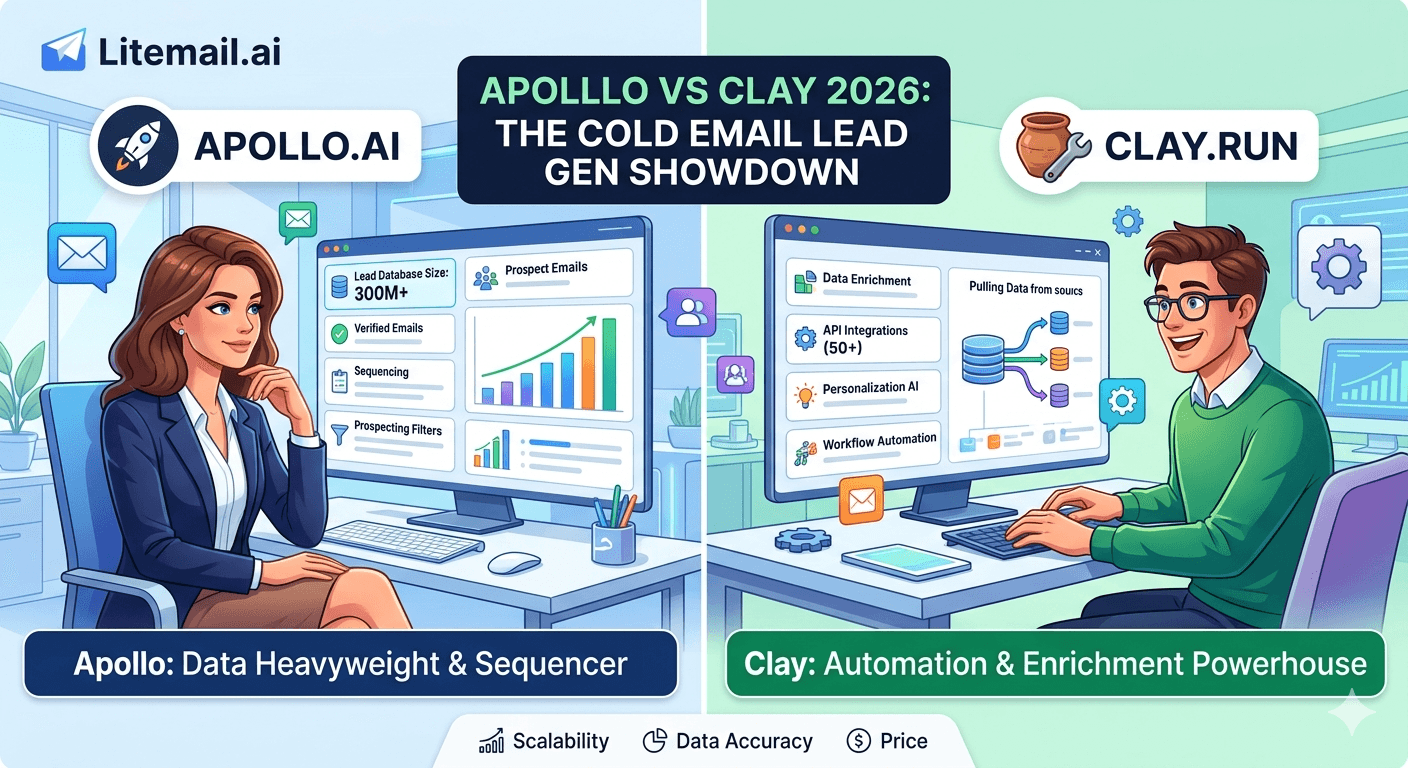
Clay Ai and Apollo Ai are two of the most discussed platforms in this space. Each claims to automate research, improve lead quality, and save hours every week. But under the surface, their approaches and results are quite different. In this article, you’ll learn how they compare across real-world use cases, pricing, data accuracy, integrations, and user experience—plus insights that most beginners overlook.
Understanding Data Enrichment
Data enrichment is the process of enhancing existing data with new, relevant details from external sources. For example, you may have a list of email addresses. With enrichment, you could add each person’s job title, LinkedIn profile, company size, or recent activity.
This process is essential for:
- Sales teams who want more context about leads before reaching out.
- Marketing teams aiming to personalize campaigns.
- Recruiters searching for candidates with specific skills.
- Product teams building user profiles.
Without enrichment, your outreach might be generic, your segmentation weak, and your analytics misleading. The quality of your data impacts every step in your workflow.
Clay Ai: What Sets It Apart?
Clay Ai is known for its flexibility and deep integration with AI-powered workflows. It’s not just a plug-and-play tool; it’s a platform for custom data enrichment and automation.
Key Features
- Custom AI Workflows: Clay Ai lets you build workflows that can fetch, analyze, and enrich data from dozens of sources, all in a single process. You can combine AI models, web scraping, and third-party APIs.
- Flexible Integrations: It connects with tools like Salesforce, HubSpot, Zapier, and Google Sheets, making it easy to fit into existing processes.
- No-Code Automation: Even non-developers can set up complex automations using a visual editor.
- Real-Time Enrichment: Fetches data in real time, so you’re never working with stale information.
- AI Research Capabilities: Clay Ai uses large language models to summarize, extract, and generate insights from text or web pages.
Typical Use Cases
- Enriching lead lists with company news, funding rounds, or recent hiring trends.
- Automating outreach personalization by generating unique icebreakers.
- Researching competitors by aggregating data from social media, news, and databases.
- Screening job candidates by compiling information from LinkedIn, GitHub, and more.
Strengths
- Extreme customization: Build exactly the workflow you need.
- Integrates AI for research and enrichment, not just static data.
- Powerful for technical teams: If you have data or automation experience, Clay Ai is a creative playground.
Weaknesses
- Steep learning curve: Beginners may need time to master all features.
- Overkill for simple needs: If you just want to add job titles to emails, Clay Ai might be more complex than you need.
- Pricing can add up if you run large automations or use premium data sources.
Clay Ai is often chosen by teams that want to experiment and optimize their data processes. It’s especially popular with growth hackers, technical marketers, and agencies.
Apollo Ai: What Makes It Unique?
Apollo Ai is part of the broader Apollo platform, focused on B2B contact data and sales intelligence. It’s designed for teams who need high-quality business data with minimal setup.
Key Features
- Large Contact Database: Access to over 260 million contacts and 70 million companies worldwide.
- Automated Enrichment: Add details like job titles, direct phone numbers, company size, and technologies used with one click.
- Intent Data: See which companies are researching solutions like yours, helping you prioritize leads.
- Built-in Outreach Tools: Send emails, sequence follow-ups, and track engagement from the same platform.
- Easy List Building: Filter by industry, location, role, seniority, and more.
Typical Use Cases
- Enriching a CRM or email list with up-to-date company and contact details.
- Prioritizing leads based on buying signals and engagement.
- Quickly building target lists for outbound campaigns.
- Updating old databases to avoid bounces and wrong numbers.
Strengths
- Fast and simple: Enrich thousands of records in minutes.
- Reliable data: Regularly updated and verified for accuracy.
- All-in-one platform: Find, enrich, and contact leads without switching tools.
- Great for sales teams: Designed around sales workflows and needs.
Weaknesses
- Less customizable: You work with Apollo’s data fields and workflows.
- Limited AI research: No custom AI-powered research or advanced automations.
- Data bias: Focused on B2B, especially US and tech industries. Less coverage in other niches.
Apollo Ai is a favorite for sales teams who want fast, reliable enrichment without technical setup. It’s also popular in recruiting and business development.
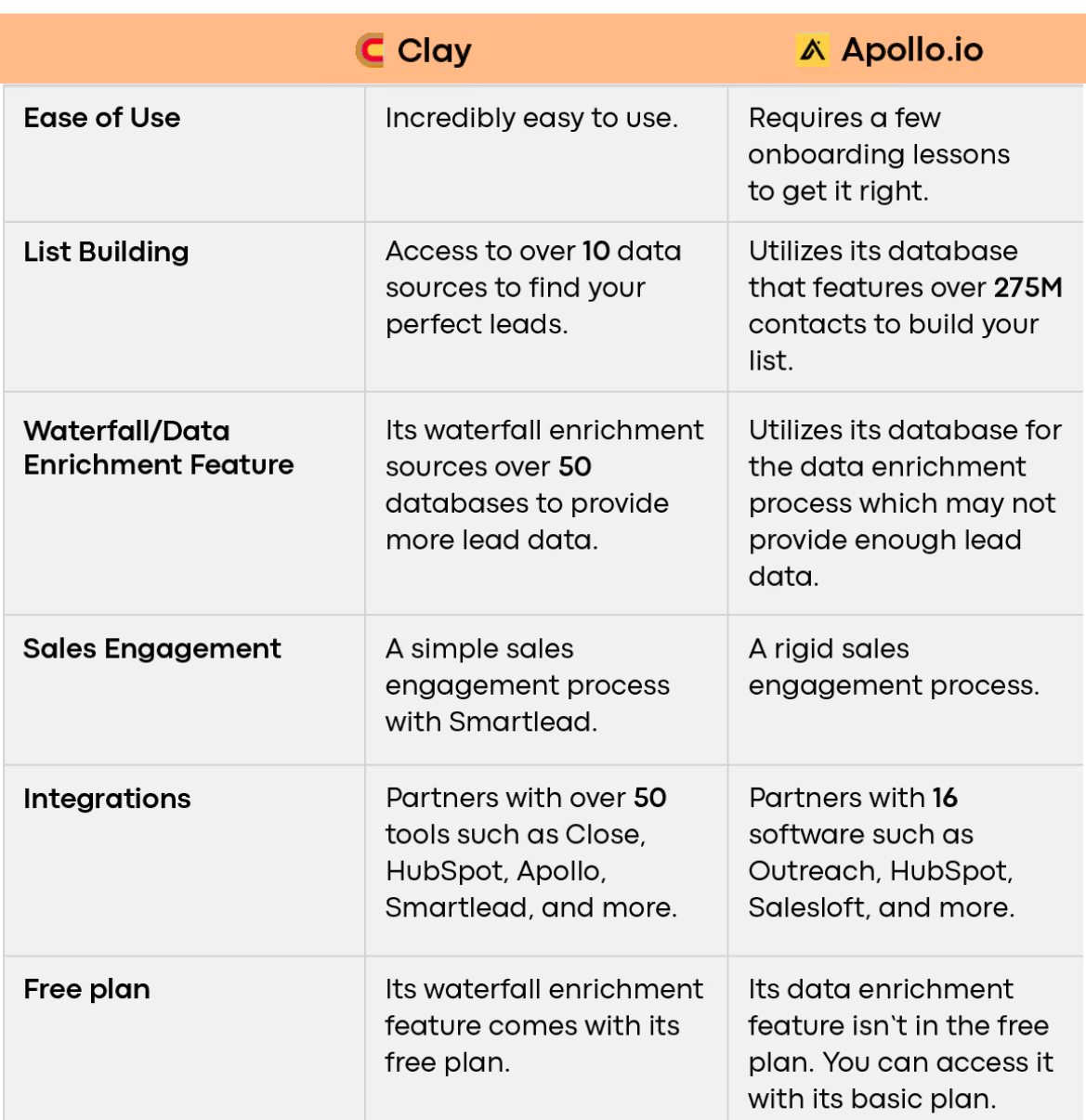
Feature-by-feature Comparison
Here’s a side-by-side look at how Clay Ai and Apollo Ai stack up on core features.
| Feature | Clay Ai | Apollo Ai |
|---|---|---|
| Data Sources | Custom APIs, web scraping, public and private data, manual uploads | Built-in Apollo database, public sources, LinkedIn, CRM sync |
| AI Capabilities | Advanced—summarization, research, custom prompts | Basic enrichment, intent signals, no custom research |
| Ease of Use | Medium to high complexity | Very easy, intuitive UI |
| Integrations | Extensive (Zapier, HubSpot, Salesforce, Google Sheets, etc.) | CRM sync, direct export, API |
| Customization | Very high—design your own workflows | Low—fixed fields and options |
| Data Update Frequency | Real-time, as-you-fetch | Regularly updated, batch enrichment |
| Pricing Model | Pay-per-use, tiered plans, extra for some sources | Subscription, credits, volume discounts |
Pricing Comparison: Which Is More Cost-effective?
Cost is a critical factor for most teams. Clay Ai and Apollo Ai price their platforms differently.
Clay Ai
- Pay-as-you-go: You pay for data usage, API calls, and AI processing.
- Tiered plans: Higher tiers unlock more automations, integrations, and premium features.
- Extra fees: Some data sources (like LinkedIn scraping or premium APIs) add to the cost.
Clay Ai’s pricing can be unpredictable if you run large or complex workflows. However, for small, focused tasks, it can be very cost-effective.
Apollo Ai
- Subscription-based: You pay a monthly or annual fee for a set number of credits.
- Volume discounts: Cheaper per credit at higher tiers.
- Free tier: Limited enrichment and search, but enough for basic testing.
Apollo Ai’s model is straightforward and easy to budget. If you need to enrich thousands of contacts every month, you’ll know your costs in advance.
Example Pricing Scenario
Suppose you want to enrich 10,000 leads per month:
- Clay Ai: Costs could range from $100 to $400/month, depending on sources and AI usage.
- Apollo Ai: Plans for this volume typically start around $150–$250/month, all-inclusive.
If you need deep research or custom workflows, Clay Ai can become more expensive. For standard B2B enrichment, Apollo Ai is usually cheaper.
Data Quality And Accuracy
Quality matters more than quantity. Enriching your list with the wrong information can hurt your campaigns.
Clay Ai’s Approach
Clay Ai pulls data from many sources, including the open web, company databases, and AI-powered extraction. This means:
- Data freshness: You get the latest info from the web or APIs.
- Variable accuracy: Some sources may be out of date or incomplete.
- AI hallucinations: Language models can sometimes generate errors or misinterpret information.
Apollo Ai’s Approach
Apollo Ai relies on its own curated database, updated regularly and checked for accuracy. This means:
- High reliability: Most fields (like job titles, emails) are verified.
- Consistent coverage: Especially strong in US and tech sectors.
- Occasional gaps: Less coverage for small companies, non-US markets, or fast-changing roles.
Real-world Accuracy Rates
- Apollo Ai: Up to 90% accuracy for emails and phone numbers in the US; lower for international.
- Clay Ai: Varies—can be 70–95% depending on source and workflow.
One non-obvious insight: Clay Ai can sometimes surface data that Apollo misses, especially for obscure contacts or recent changes. But Apollo’s results are more consistent for standard business lists.
Credit: bitscale.ai
Integration And Workflow Automation
How easily do Clay Ai and Apollo Ai fit into your stack?
Clay Ai
- Zapier, Make, and direct API: Connect with almost any app.
- Google Sheets integration: Sync enrichments to live spreadsheets.
- Custom triggers and logic: Build multi-step automations, like “if LinkedIn says X, then fetch news from Y.”
For teams with technical resources, Clay Ai can automate nearly any workflow.
Apollo Ai
- CRM integrations: One-click sync with Salesforce, HubSpot, and other CRMs.
- Native workflows: Enrich leads as they enter your system.
- Limited custom logic: You can’t build complex branching automations.
For most sales teams, Apollo’s integrations are more than enough. For advanced use cases, Clay Ai wins.
User Experience And Support
A tool’s interface and support matter, especially when you’re on a deadline.
Clay Ai
- Visual workflow editor: Build enrichment flows step by step.
- Learning resources: Tutorials, webinars, and a growing community.
- Support: Responsive for paid tiers, but DIY for free users.
Beginners may feel overwhelmed at first, but power users appreciate the control.
Apollo Ai
- Simple UI: Search, enrich, and export in minutes.
- Onboarding: Guided tours and fast setup.
- Support: Live chat and phone support for all paid users.
If you want to “just get it done,” Apollo Ai is easier to start with.
Use Cases: Which Platform Fits Your Needs?
Let’s look at typical scenarios and which platform is best suited.
1. High-volume Lead Enrichment For Sales
If you have lists of thousands of prospects and need standard fields (name, job, email, company), Apollo Ai is faster and cheaper. Its database is designed for bulk enrichment, and accuracy is high for B2B contacts.
2. Custom Research And Personalization
If you want to go beyond standard fields—like adding a recent news mention, a unique LinkedIn insight, or AI-generated icebreakers—Clay Ai is unbeatable. Its AI and web automation tools let you personalize at scale.
3. Updating Old Crm Data
Both tools can update stale CRM records. Apollo Ai is simpler for standard business fields. Clay Ai can help if you need to fill in missing data from niche sources or the open web.
4. Recruiting And Talent Sourcing
For standard recruiting (finding emails, roles, company info), Apollo Ai works well. If you want to enrich with GitHub contributions, portfolio sites, or AI-analyzed resumes, Clay Ai offers more options.
5. Competitive Intelligence
Clay Ai shines for research-heavy tasks, like tracking competitors’ news, funding, or hiring trends. You can set up workflows to pull the latest from diverse sources, something Apollo Ai doesn’t support natively.
Advanced Features And Overlooked Capabilities
Most comparisons stop at basic features, but two advanced areas are often overlooked:
Ai-powered Data Extraction
Clay Ai can use large language models to extract structured data from unstructured sources—like pulling a funding date from a press release, or summarizing a CEO’s recent interview. This goes far beyond standard enrichment.
Automated Personalization At Scale
With Clay Ai, you can build automations that not only enrich a lead’s profile but also generate custom email openers, LinkedIn comments, or talking points—all unique to each contact. This is a level of personalization that Apollo Ai doesn’t offer.
One more insight: Clay Ai workflows can combine multiple data points and automate decisions (like “Only enrich contacts from companies that raised funding in the last 6 months”), saving hours on manual research.
Data Privacy And Compliance
Both platforms take data privacy seriously, but their approaches differ.
- Clay Ai: You choose your data sources, so responsibility for compliance may fall on you. Be careful when scraping public data or using personal information.
- Apollo Ai: Aggregates and verifies data under strict compliance rules (GDPR, CCPA). Safer for regulated industries.
If compliance is a top concern, Apollo Ai’s standardized data may be less risky.
Customer Reviews And Reputation
How Do Real Users Rate These Tools?
Clay Ai
- G2 rating: 4.7/5 (based on 150+ reviews)
- Praised for: Flexibility, depth, creative automation.
- Criticized for: Steep learning curve, occasional bugs with new features.
Apollo Ai
- G2 rating: 4.8/5 (based on 4,000+ reviews)
- Praised for: Data quality, ease of use, sales integrations.
- Criticized for: Data gaps outside US/tech, limited advanced workflows.
Credit: litemail.ai
Example Workflows: Clay Ai Vs Apollo Ai
To make things concrete, here are two example workflows.
Clay Ai Example
Goal: Enrich a list of startup founders with their latest funding round, LinkedIn profile, and a personalized icebreaker.
Steps:
- Input a list of company names or domains.
- Use web scraping to find recent news articles mentioning funding.
- Pull LinkedIn profiles via API.
- Use AI to generate a 1-sentence icebreaker for each founder.
- Export enriched list to Google Sheets.
This level of automation is unique to Clay Ai.
Apollo Ai Example
Goal: Update a CRM with the latest job titles and emails for a prospect list.
Steps:
- Upload the list to Apollo Ai.
- Select enrichment fields (title, email, phone).
- Run enrichment and export results.
- Sync updated data back to CRM.
This can be done in minutes, with minimal setup.
Limitations Of Each Platform
No tool is perfect. Here’s what to watch out for.
Clay Ai
- Custom workflows can break if a data source changes.
- Some data (like emails) may not be as verified as Apollo’s.
- Costs can spike with heavy AI or third-party API usage.
Apollo Ai
- Limited custom research—what you see is what you get.
- May miss recent changes, as database updates are not always real-time.
- Less useful for non-sales use cases or niche industries.
How To Choose: Decision Factors
Still unsure? Consider these criteria:
- Your use case: Do you need advanced research or standard enrichment?
- Team skill level: Are you comfortable building workflows, or do you want plug-and-play?
- Volume and budget: How many records do you enrich monthly, and what can you spend?
- Data coverage: Are your leads mostly in B2B, US, or tech? Apollo Ai is strong here. For global or niche, Clay Ai may find more.
- Compliance needs: If strict privacy is required, Apollo Ai’s curated data is safer.
Comparative Data Table: Summary At A Glance
Here’s a quick reference table for key decision points.
| Decision Factor | Clay Ai | Apollo Ai |
|---|---|---|
| Best for | Custom research, advanced automation, personalization | Sales teams, bulk enrichment, B2B data |
| Learning curve | Steep (more powerful) | Easy (less flexible) |
| Pricing predictability | Variable, pay-as-you-go | Fixed, subscription-based |
| Data coverage | Any source you connect | Apollo’s internal database |
| Compliance | User responsibility | Vendor responsibility |
Expert Tips For Getting Maximum Value
- Start small and scale: Test each tool with a sample list before committing. This helps spot errors or gaps early.
- Combine tools: Some teams use Apollo Ai for standard enrichment, then Clay Ai for personalized research.
- Monitor costs: Especially with Clay Ai, keep an eye on API and AI usage to avoid surprises.
- Update regularly: Data grows stale quickly. Schedule re-enrichment every 3–6 months for best results.
- Leverage integrations: Connect your enrichment tool with CRM, email, and other systems for a seamless workflow.
The Bottom Line
Choosing between Clay Ai and Apollo Ai for data enrichment is not just about features—it’s about the way your team works and what you need most. If you want fast, accurate B2B data with minimal setup, Apollo Ai is a reliable pick. If you crave deep research, creative automation, or personalization at scale, Clay Ai opens a world of possibilities.
Remember, the most expensive mistake is using the wrong data. Take the time to test, review, and optimize your enrichment process. The right platform can boost your pipeline, improve targeting, and save your team hours every week.
For more detailed comparisons and user reviews, you can check out G2’s Sales Intelligence category.
Credit: www.outreachark.com
Frequently Asked Questions
What Is The Main Difference Between Clay Ai And Apollo Ai?
Clay Ai is focused on custom research and automation, letting you build advanced workflows and pull data from any source you connect. Apollo Ai is built for fast, reliable B2B enrichment using its own large database, with an emphasis on sales and marketing use cases.
Can I Use Both Clay Ai And Apollo Ai Together?
Yes, many teams enrich their leads with Apollo Ai first for basic fields, then use Clay Ai for deeper research or personalization. Combining both can give you the best of speed and depth.
Which Tool Is More Accurate For Emails And Phone Numbers?
Apollo Ai is generally more accurate for standard business fields like emails and phones, especially in the US and tech sectors. Clay Ai can sometimes find unique or niche data, but accuracy depends on the sources you use.
Is Clay Ai Or Apollo Ai Better For Global Data?
Clay Ai can access global sources if you configure it, making it better for non-US or niche industries. Apollo Ai’s strength is in US and tech B2B data, with less coverage internationally.
How Do I Know Which Tool Is Right For My Team?
Start by defining your main use case. If you need simple, fast enrichment for sales outreach, Apollo Ai is a safer bet. If you have complex research or want to build unique automations, Clay Ai is worth the investment. Testing both with a sample list will reveal which fits your workflow best.


About author








Add comment