

Appsumo Lifetime Deals Vs Monthly Software Costs: Which Saves More?
Every business needs the right software tools to grow. But the cost of software can quickly add up, especially for small companies, startups, and freelancers. Two popular ways to buy software today are through AppSumo lifetime deals and traditional monthly software subscriptions. Each method has strong fans—and serious drawbacks. Choosing the right approach can save you thousands of dollars or cause major headaches down the road.
This article dives deep into the real differences between AppSumo lifetime deals and monthly software costs. You’ll see how each model works, when each one makes sense, and where people often make mistakes. We’ll look at pricing, value, risks, and even some real-life examples.
By the end, you’ll have a clear understanding of which approach fits your business—and how to avoid the most common pitfalls.
What Are Appsumo Lifetime Deals?
AppSumo is a popular online marketplace that offers software deals at a one-time price, often called “lifetime deals.” Instead of paying every month, you pay a single fee and get access to the software for as long as it exists. These deals are usually offered for a limited time, often to help new or growing software companies get users and feedback.
How AppSumo Lifetime Deals Work:
- You pay a single fee, usually between $39 and $99.
- In return, you get access to the software—sometimes forever, sometimes for as long as the company stays in business.
- The deal may include extra perks, such as higher limits or bonus features.
- Most deals are “stackable,” meaning you can buy multiple codes for more features or higher usage limits.
AppSumo started in 2010 and has helped launch hundreds of software tools, especially in marketing, productivity, and business automation. Some deals become famous because users get years of value for a very low price.
How Do Monthly Software Subscriptions Work?
Most software companies today use a subscription model. You pay a monthly (or annual) fee to keep using the software. This model is called “SaaS” (Software as a Service).
How Monthly Subscriptions Work:
- You pay a set fee every month or year.
- As long as you pay, you get access to the software, updates, and support.
- If you stop paying, you lose access (sometimes immediately, sometimes after a grace period).
- Prices can range from $5/month for simple tools to $100/month or more for advanced software.
This model is common for everything from project management tools like Asana, to design apps like Canva, to CRMs like HubSpot.
Price Comparison: Appsumo Lifetime Deals Vs Monthly Subscriptions
To really understand the value, let’s compare typical costs for both models. Here’s a look at a few real-world examples:
| Software | AppSumo Lifetime Deal | Regular Monthly Price | 12-Month Cost (Subscription) | Payback Period (Months) |
|---|---|---|---|---|
| SendFox (Email Marketing) | $49 (one-time) | $24/month | $288 | ~2 months |
| Depositphotos (Stock Images) | $39 (100 images) | $29/month (30 images) | $348 | ~1.3 months |
| SocialBee (Social Media Tool) | $59 (lifetime) | $19/month | $228 | ~3 months |
As you can see, the payback period (the time it takes for the lifetime deal to become cheaper than the monthly fee) is usually just 1–3 months. After that, the savings can be huge.
But price isn’t the only thing that matters. Let’s look at what else you get (or risk) with each model.
Pros And Cons Of Appsumo Lifetime Deals
AppSumo lifetime deals are famous for their value—but they also have some real risks. Here’s what you need to know.
Pros
1. Massive Savings
If you use the software for even a few months, you often save hundreds of dollars compared to paying monthly.
2. No Ongoing Payments
You don’t have to worry about monthly bills, failed credit cards, or surprise price hikes.
3. Early Access To New Tools
Many deals are for new software, so you can get features before they become mainstream.
4. Stacking And Bonuses
Some deals let you “stack codes” for more usage or advanced features, sometimes at a fraction of the future cost.
5. Resale Value (sometimes)
If a tool becomes popular, some users can resell their lifetime codes (if the terms allow), though this is not always possible.
Cons
1. Company May Shut Down
The biggest risk: if the company fails, you lose access—sometimes with little warning.
2. Limited Features
Lifetime deals may not include every feature. You may get “basic” or “starter” plans, with upsells for advanced tools.
3. Support And Updates Can Decline
As companies grow, they may focus on paying (subscription) users, not lifetime deal buyers. Support quality may drop.
4. No Refunds After 60 Days
AppSumo gives a 60-day refund window, but after that, you’re locked in—even if the software changes or declines.
5. Not Always Needed
It’s easy to buy tools “just in case,” then never use them. This can waste money, not save it.
Non-Obvious Insight: Many people buy lifetime deals for tools that sound cool but don’t fit their workflow. The real savings come only when you use the tool regularly.

Credit: www.strieglerphoto.com
Pros And Cons Of Monthly Software Subscriptions
Monthly subscriptions are everywhere for a reason. But they also come with their own trade-offs.
Pros
1. Always Up To Date
You get the latest features, improvements, and bug fixes—often faster than lifetime deal users.
2. Full Support
Subscription customers usually get priority for customer service, bug reports, and feature requests.
3. Flexible And Scalable
You can upgrade, downgrade, or cancel anytime. Perfect for changing business needs.
4. Access To Premium Features
Monthly plans often include full access to all features, integrations, and add-ons.
5. Lower Entry Cost
You can try a tool for a month for a small fee—no big upfront payment.
Cons
1. Costs Add Up
If you use many tools, monthly fees can become a big expense over time.
2. Price Increases
Companies can (and often do) raise prices. You may be forced to pay more just to keep using the same tool.
3. Lose Access If You Stop Paying
Miss a payment, and your account may be locked, sometimes with data loss.
4. Commitment Pressure
Some companies push for annual contracts, locking you in for 12 months (even if you pay monthly).
5. No Ownership Feeling
You’re renting, not owning. Some users prefer the sense of ownership from a lifetime deal.
Non-Obvious Insight: Many people forget to track their subscriptions, leading to “subscription creep”—paying for software they no longer use.
Value Over Time: Real Cost Analysis
Let’s look at how costs add up over several years. This is where the difference between the two models becomes dramatic.
Cost Over 3 Years
Imagine two businesses, each using five tools. One buys all their tools as AppSumo lifetime deals; the other pays monthly.
- Average AppSumo Deal: $59 one-time x 5 = $295 (total for 3 years)
- Average Monthly Subscription: $25/month x 5 tools = $125/month x 36 months = $4,500 (over 3 years)
That’s a difference of more than $4,000 over three years. Even if you only use half the tools regularly, lifetime deals can still save you thousands.
But remember, these numbers are only true if:
- The tools stay in business
- You keep using them
- The features remain useful
If you stop using a tool, or if the company shuts down, the savings disappear.
Feature Access: What Do You Really Get?
Not all lifetime deals are created equal. Sometimes, the “lifetime” access is limited in important ways.
Common Limitations In Lifetime Deals
- User or usage limits: You may only get 1–3 users, or a lower quota for emails, projects, or storage.
- Missing integrations: Some features (like API access or premium integrations) are only for monthly subscribers.
- No upgrades: You might not get new features added after the deal ends, while monthly users do.
How Monthly Subscriptions Compare
- Full features: Monthly plans often include all new features and integrations.
- Flexible upgrades: You can pay more to unlock higher limits or add more users.
- Better support: Subscription users are the main focus for most SaaS companies.
Non-Obvious Insight: Many companies use lifetime deals as a marketing tool, offering just enough to hook users but reserving the best features for paying subscribers.
Risks Of Lifetime Deals: What Can Go Wrong?
Lifetime deals sound amazing, but there are real risks that buyers often overlook.
Company Failure
The biggest risk is that the company shuts down. Young startups are especially vulnerable. If the software disappears, your one-time payment is gone forever.
Product Changes
Companies may change their business model, drop features, or limit what lifetime users get. Sometimes, lifetime users are moved to lower plans.
Support Drops
As companies grow, they may put more resources into paying (subscription) users. Lifetime deal buyers may get slower or no support.
Data Loss Or Migration
If a tool closes, you may lose your data or have a hard time moving it elsewhere.
Real-life Examples
- Mailshake (originally on AppSumo) later limited lifetime users to fewer features.
- OnePageCRM removed key integrations from lifetime deal accounts.
- Several tools (like EpicBeat and Zoom.ai) shut down, leaving users with nothing.
Who Should Choose Appsumo Lifetime Deals?
Lifetime deals are not for everyone. Here’s who benefits most:
- Startups and freelancers with limited budgets
- People who are willing to try new tools and adapt
- Businesses that want to lock in low costs for years
- Users with simple needs who don’t require every advanced feature
When Lifetime Deals Make Sense
- You need the tool now (not just “maybe later”)
- You plan to use it for at least 6–12 months
- The company seems stable (research the founders, reviews, and roadmap)
- The deal includes the features you need
Who Should Stick With Monthly Subscriptions?
Monthly subscriptions are the best fit for:
- Established businesses that need reliability and support
- Teams that need advanced features, integrations, or high usage limits
- Users who value regular updates and the latest features
- Companies that need guaranteed uptime, security, and compliance
When Subscriptions Are Better
- You need mission-critical features or integrations
- You want strong customer support
- Your business can absorb the monthly cost
- You don’t want to risk losing access or data
Hidden Costs And Mistakes To Avoid
Even smart buyers make mistakes with both models. Here are some common pitfalls:
For Lifetime Deals
- Overbuying: Buying too many deals, then never using them.
- Ignoring refund policies: Waiting too long to test the tool, then missing the 60-day refund window.
- Not checking limitations: Missing hidden limits on users, storage, or features.
- Not researching the company: Buying from companies with no history, poor reviews, or unclear roadmaps.
For Monthly Subscriptions
- Forgetting to cancel unused tools: Letting monthly fees pile up for software you no longer use.
- Not checking for discounts: Many tools offer discounts for annual billing or new users.
- Not tracking price changes: Some companies raise prices quietly. Watch your invoices.
- Overpaying for unused features: Paying for higher plans when you only need basic features.
Evaluating The Real Value: What To Ask Before You Buy
No matter which model you choose, these questions can save you money and headaches:
1. Will I Use This Tool Regularly?
If Not, Skip It—even If It’s A “great Deal.”
2. Are The Features I Need Included?
Check for limits on users, integrations, or key functions.
3. What Happens If I Stop Paying (for Subscriptions)?
Will You Lose Data, Access, Or Key Features?
4. How Stable Is The Company?
Look for real customer reviews, an active support team, and a clear product roadmap.
5. What Is The Refund Policy?
For AppSumo, the 60-day refund is generous—but only if you test the tool right away.
Non-Obvious Insight: Many software companies launch on AppSumo to get early customers, then quickly switch to monthly pricing. Lifetime deal users may become a low priority as the company grows.
Case Study: Real-world User Experiences
Let’s look at a few real stories from business owners and freelancers who have used both models.
Freelance Marketer: Sarah’s Story
Sarah is a freelance marketer who bought 12 lifetime deals from AppSumo in 2020. She used only five of them regularly. Here’s what happened:
- Savings: She saved about $2,000 over two years compared to paying monthly.
- Downside: Three tools she bought shut down within a year. Two others stopped updating, so she switched to paid alternatives.
- Lesson: “Lifetime deals are great if you actually use the tool. But I bought too many. Now I only buy what I need and test it during the refund period.”
Small Agency: Mike’s Experience
Mike runs a small web agency. He prefers monthly subscriptions for his main tools (like project management and CRM) but uses lifetime deals for extras.
- Why: “For mission-critical stuff, I want strong support and updates. But for things like social media scheduling or video editing, the lifetime deals are perfect.”
- Result: He spends about $200/month on subscriptions, but has saved over $3,000 on less important tools through lifetime deals.
Saas Founder: Priya’s Approach
Priya runs a SaaS startup. She avoids lifetime deals for her business but recommends them to early-stage entrepreneurs.
- Insight: “Lifetime deals are great for bootstrapping and testing new tools. But for my team, I want the best support and features, which usually means monthly plans.”
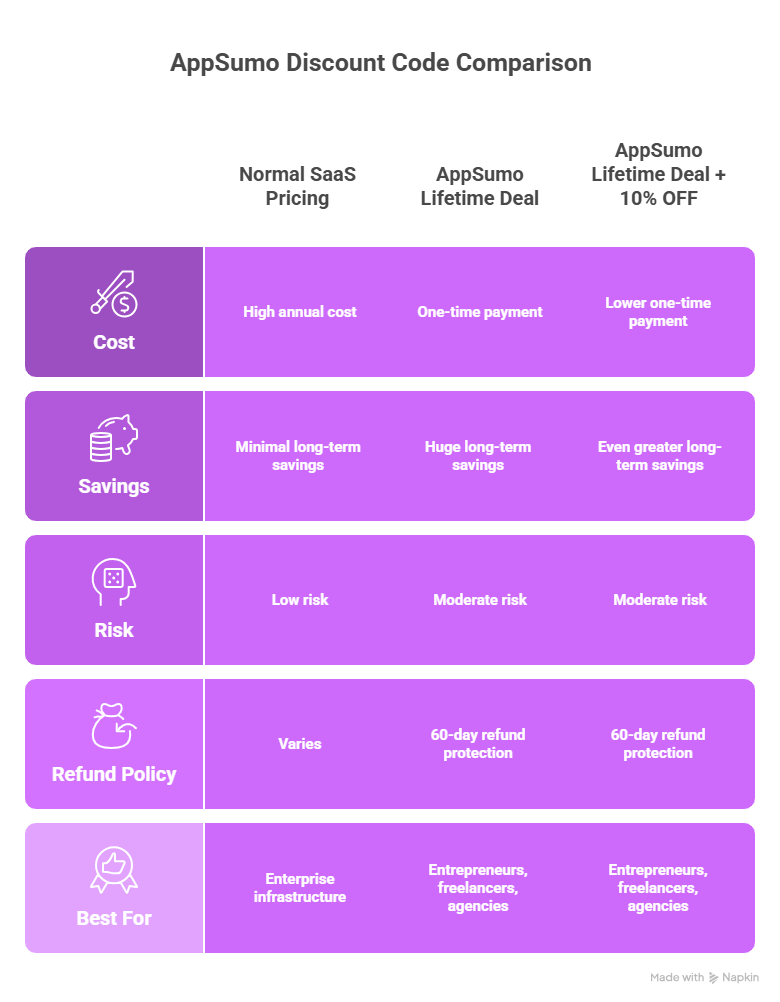
Comparing Appsumo Lifetime Deals And Monthly Software: Side-by-side
Here’s a quick comparison to highlight the key differences:
| Factor | AppSumo Lifetime Deals | Monthly Subscriptions |
|---|---|---|
| Upfront Cost | High (one-time) | Low (monthly) |
| Long-Term Cost | Very low | High |
| Feature Access | Can be limited | Full (usually) |
| Support Quality | May decline over time | Consistently high |
| Updates | Sometimes limited | Always included |
| Risk of Loss | High (company could close) | Low |
| Flexibility | Low (no refunds after 60 days) | High (can cancel anytime) |
| Best For | Budget users, early adopters | Established businesses, critical tools |
Credit: appsumo-discount-code.webflow.io
How To Decide: Key Questions To Guide Your Choice
If you’re still unsure, ask yourself these questions:
- Is this tool essential to my work or just “nice to have”?
- Would losing access cause big problems for my business?
- Do I need the latest features and integrations?
- How long do I expect to use this tool?
- Am I comfortable with some risk to save money?
If the tool is essential, supports your main business, or you need the best support—monthly subscriptions are safer. If you’re experimenting, watching your budget, or the tool is “extra,” a lifetime deal can be a great value.
Tips For Getting The Best Value
Here are some practical ways to get the most from both models:
- Test every tool during the refund period. Don’t just buy and forget.
- Track all your software in a spreadsheet. Include the purchase date, renewal date, and features.
- Set reminders for subscription renewals. Avoid paying for unused tools.
- Join communities (like AppSumo’s Facebook group). Learn from real user experiences and company updates.
- Check for discounts and stack deals. Some companies offer extra codes, upgrades, or bonus features for early buyers.

Credit: www.strieglerphoto.com
The Future Of Software Pricing: What’s Changing?
The software market is always changing. Here’s what experts see coming:
- Fewer true lifetime deals. As SaaS companies mature, they rely less on lifetime deals and more on recurring revenue.
- Hybrid pricing models. Some tools now offer a one-time “lifetime” payment, but only for a set number of years or features.
- More flexible subscriptions. Some companies offer “pause” or “seasonal” plans to help users save money.
- Growing importance of integrations. As businesses use more tools, the ability to connect apps (via API or Zapier) becomes a must-have.
For more on SaaS industry trends, visit the SaaStr blog.
Frequently Asked Questions
What Happens If A Company Offering A Lifetime Deal Shuts Down?
If the company closes, you usually lose access to the software and your data. This is the biggest risk with lifetime deals. Always back up your data and use lifetime deals for non-critical tools.
Are All Features Included In Appsumo Lifetime Deals?
Not always. Many deals include only certain features or user limits. Read the terms carefully before buying to make sure you get what you need.
Can I Combine Appsumo Deals With Monthly Subscriptions?
Yes. Many businesses use lifetime deals for extras and pay monthly for their main tools. This can help balance cost savings with reliability.
Is There A Refund Policy For Appsumo Lifetime Deals?
Yes, AppSumo offers a 60-day refund window for most deals. After that, you cannot get your money back—even if you stop using the tool.
How Do I Know If A Lifetime Deal Is Worth It?
Ask yourself if you’ll use the tool for at least 6–12 months, if the features fit your needs, and if the company looks stable. Test the tool during the refund period, and only keep it if it adds real value.
—
Choosing between AppSumo lifetime deals and monthly software costs is a big decision. Each approach has real strengths and weaknesses. If you’re careful, do your homework, and stay focused on what your business truly needs, you can get the best of both worlds: powerful tools at a price you can afford, without the risk of overpaying or losing access when you need it most.


About author








Add comment